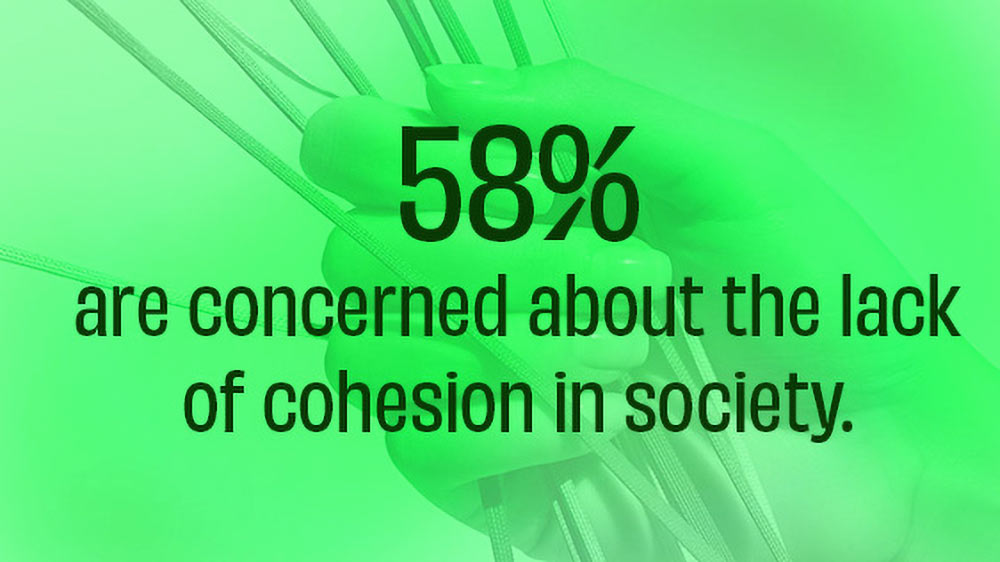
58% of the participants in
"ORF fragt", an online survey with nearly 80,000 responses, are concerned about societal cohesion. 49% believe social media divides society, 59% think children should be kept away from it as long as possible, and 72% agree that people should talk directly to each other more often instead of spending so much time on social media.
At the same time, the "integration function" is one of the central functions of media: it ensures one feels part of a larger society. In connection with multi-ethnicity, the ORF magazine "betrifft uns – Reportagen ohne Filter" aims to foster mutual understanding that can contribute to societal cohesion. Ajda Sticker, an award-winning ORF journalist, states:
"betrifft: uns – Reportagen ohne Filter' was developed as a successor format for the program “Heimat fremde Heimat” and aims to bring the topics of multi-ethnic coexistence into modern times. Many people with diverse migration backgrounds live in Austria. And we want to showcase the opportunities and challenges of this multi-ethnic coexistence in Austria by engaging with communities, addressing the concerns of native Austrians, and attempting to bundle this in a 30-minute report. Our mission is to highlight both challenges and the problems a migration society brings. However, I truly believe that most people who come or have come are not the problem, and we should focus uncritically, journalistically correctly, and respectfully on how many different people live in our country. We are open to criticism and are working on it. When we make our reports, we notice that ORF is not actually used in some communities. ORF could help a little by promoting young people with migration backgrounds and making them visible also as journalists, as I believe there is a lot of potential in our society."
Science also formulates cohesion as a public task, according to Flavia Barca in
"PUBLIC VALUE TEXTE 29":
"The social impact of media is also crucial in combating fragmentation processes and demanding instruments for negotiating meaning (Barca 2023). The task of connecting generations and closed bubbles and demanding coexistence of identity and diversity is urgent and marks an equal and opposite direction to that in which commercial platforms are moving. Public broadcasting can become a competitive space where different social and cultural values engage in dialogue, a space for negotiation."
Jürgen Betz and Erika Bock-Rosenthal from the “Initiativkreis öffentlich-rechtlicher Rundfunk" also consider it an essential task to "fulfill the mission of integration, i.e., to promote coexistence in a pluralistic society through a culture of understanding, communication, and discourse."
Integration as Public Value Category
The category "Integration" documents ORF's performance, among other things, in relation to ethnic groups, migration, and globalization. The category is based, among other things, on the following passages from
ORF regulations:
ORF-Gesetz
§ 4. (5a) Im Rahmen der gemäß § 3 verbreiteten Programme sind angemessene Anteile in den Volksgruppensprachen jener Volksgruppen, für die ein Volksgruppenbeirat besteht, zu erstellen.
§ 10. (3) Das Gesamtangebot hat sich um Qualität, Innovation, Integration, Gleichberechtigung und Verständigung zu bemühen. ORF-Programmrichtlinien Die Angebote des ORF haben zum Abbau von Vorurteilen, insbesondere aufgrund von Herkunft, Geschlecht, Alter, Behinderung, Religion, Nationalität, politischer Gesinnung, Homosexualität, ethnischer, kultureller und sozialer Zugehörigkeit, beizutragen.
ORF Quality Profile
Entertainment offerings should appeal to Austrians, but also to all people living in Austria. In this sense, entertainment should also consider aspects of migration, multiculturalism, and social inclusion in the selection, production, and design of entertainment formats and thus contribute to conveying an authentic and contemporary image of Austria.
Figures & Data
Below you will find exemplary numbers documenting the fulfillment of the public service mandate and the associated media quality. (Figrues & Data only available in german.) Further information can be found in the
ORF's annual report to the Federal Chancellor and regulatory authority, the
transparency report, the business and sustainability report, as well as the reports on equality (
ORF Public Value - DOCUMENTS), the action
plan for accessibility, or the
annual and consolidated financial statements of ORF.
Exemplary Figures
Inklusion im TV
Themen Migration & Diversität im ORF-Archiv
| Asyl |
648x |
| Feminismus |
82x |
| Flucht |
753x |
| Gleichberechtigung |
128x |
| Inklusion |
322x |
| LGBTQIA+ |
116x |
| Mental Health / Psychische Gesundheit |
184x |
| Rassismus |
186x |
"betrifft:uns" - Reportagen ohne Filter - Top 3 | 44x ausgestrahlt
| Inhalt |
Sender |
Datum |
Tsd. |
| Abschiebung - Wer darf bleiben, wer muss gehen? |
ORF 2 |
29.03. |
167 |
| Hat der Reumannplatz seinen schlechten Ruf wirklich verdient? |
ORF 2 |
17.05. |
152 |
| Christkindlmärkte: Wer sind die Menschen hinter dem Weihnachtszauber? |
ORF 2 |
06.02. |
149 |
Sag's Multi - Mehrsprachiger Redewettbewerb für Schüler:innen
384
Teilnehmer:innen in der Vorrunde |
77,34%
Teilnehmer:innen |
191
der Teilnehmer:innen haben Deutsch als Erstsprache |
193
der Teilnehmer:innen haben Deutsch als Fremdsprache |
| 6 Themen |
| Zusammenhalt in Vielfalt – Was uns stark macht |
| Zwischen Fake und Wahrheit – Wem können wir glauben? |
| Gerechtigkeit – Ein großes Wort, viele Bedeutungen |
| Zukunft Europa – Reden. Handeln. Mitgestalten. |
| Meine Generation – Hoffnungsträger:innen oder Sorgenkinder? |
| Online. Offline. Echt? |
| 38 Sprachen |
#inclusion
Download as PDF